
Name-Based Case Searches
Pick the right court first, then search by name. Felony cases sit with the District Clerk. So do district civil suits, family matters, and the 109th Judicial District Court. Misdemeanors filed in Constitutional County Court, along with probate, go through the County Clerk instead. Justice Court civil filings and county traffic tickets are different. The JP clerk handles that docket through the Tyler portal. Crane Municipal Court keeps its own city ordinance and city Class C cases. That court offers no public case portal. A name search there means calling or visiting the clerk.
- Choose Cases or Hearings in re:SearchTX when the statewide portal is available, or open the venue-specific local route.
- Enter the shortest accurate party name. The official guide documents an asterisk wildcard, such as joh*, for some supported party, attorney, or judge fields.
- Narrow by Crane County, court, case type, category, or filing period when those controls appear.
- Compare the party role, location, filed date, and case type before opening a result.
- Read the event and hearing history, then confirm important details with the responsible clerk.
The field descriptions here come from the statewide guide rather than a live Crane screen. The portal answers automated visitors with an HTTP 403 response, so current labels may differ.
| Field label | Type | Required | Notes |
|---|---|---|---|
| Search By | Selector | Yes | Choose a supported party, attorney, judge, or other route |
| Name | Text | Varies | Use a short accurate spelling; wildcard support is field-dependent |
| Cases or Hearings | Choice | Yes | These searches answer different questions |
| Location or type | Filter | No | Narrow broad results to Crane and the right case class |
Crane County Cases and Hearings
Crane County links searchers to the re:SearchTX Court Records Search as its statewide route. The official quick guide splits the tool into Cases and Hearings. An Advanced control sits beside the search box. A case result helps you locate a file and its activity history. A hearing result points to scheduled events instead. The guide's sorting choices include newest filed date, oldest filed date, and case number.
The guide also mentions save-to-folder, alerts, sharing, export, filing, and document-cart actions. Whether those work depends on account status, user role, court integration, and the record itself. The landing page turns automated visitors away with a 403. So treat these features as guide descriptions rather than proof of current Crane coverage. Follow the county link as the intended route and keep the clerk fallback ready. For reference, the official statewide search landing shows the entry point itself.
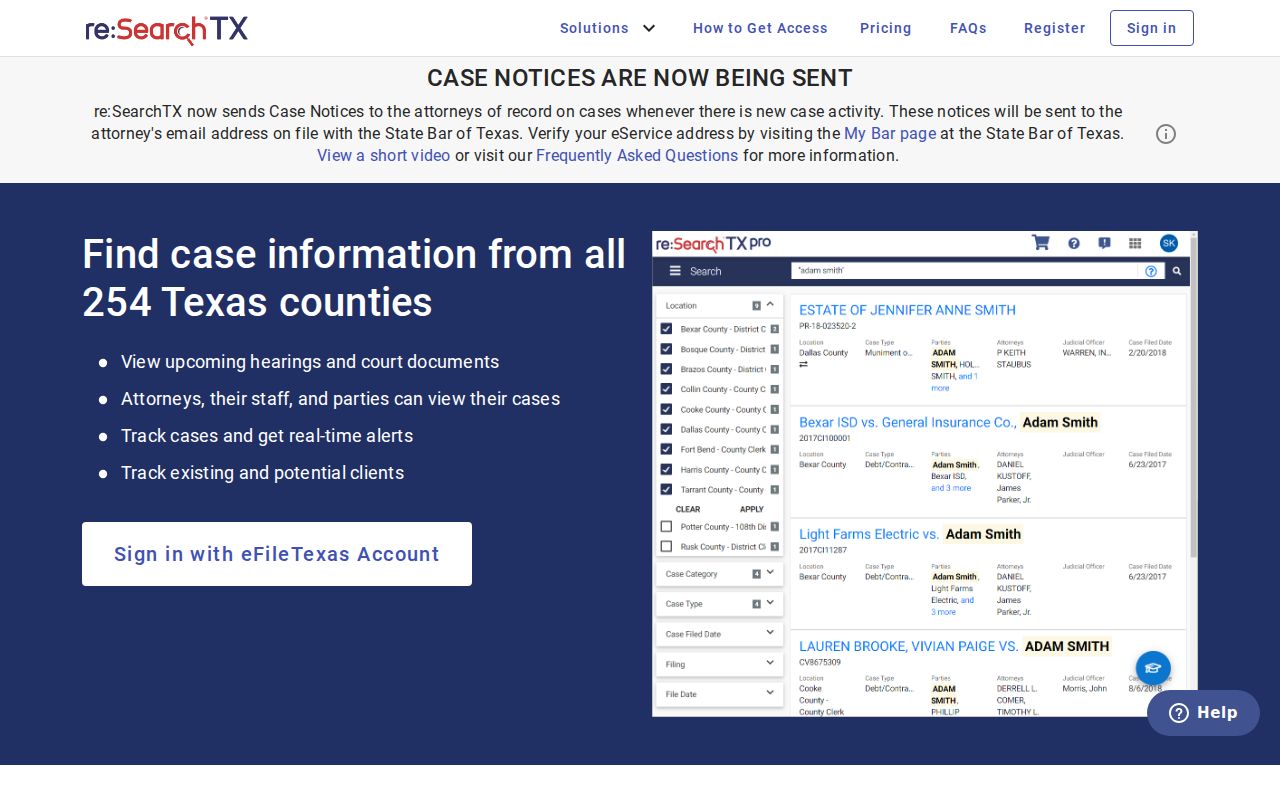
That access barrier is exactly why a Crane County docket search needs phone, counter, and written-request options alongside the online link. One blocked page should never be the end of the road.
Case Number Searches
A full cause number is usually the cleanest identifier. No single local number pattern spans all four Crane court levels, so keep every segment. Enter the number exactly as the notice shows it. Letters, year digits, dashes, and leading zeroes all belong. A safe display example is [full cause number as issued] rather than any claimed Crane format.
When an exact search comes up empty, check for typos and confirm the venue. A JP citation number is not a 109th District Court cause number. The Texas Topics notice search also accepts a cause number. But it covers citations by publication and public notices, not ordinary traffic tickets. If the number is valid yet nothing appears, call the proper clerk.
Crane County Case Search Terms
Search screens use compact labels. Knowing what each one means prevents false matches and makes a clerk request more precise.
- Cause number
- The court-assigned identifier for one case.
- Case type
- A classification such as civil, family, criminal, probate, juvenile, or municipal.
- Case category
- A broader grouping used by re:SearchTX in its representative case-information view.
- Location
- The court or county attached to the record, not necessarily the place of every hearing.
- Style
- The short caption, often formed from party names.
- Event
- One line in the chronological activity history.
"Register of actions" is just another name for the docket history. A filing is an item submitted to the court. A document is the filed material itself, which may be viewable, restricted, or sold separately.
Case Search Results Explained
The official representative interface shows case information, parties, attorneys, judicial officers, filings, documents, hearings, and events. Availability depends on the court. It is not a sample Crane case. Public detail varies with the court, user role, and record status. Metadata can be visible even when the document image is not.
| Case number | The identifier issued by the court; preserve its full displayed form. |
|---|---|
| Style or parties | The caption and role labels, which help separate people with similar names. |
| Case type | The civil, family, criminal, probate, juvenile, justice, or municipal classification. |
| Filed date | The initiation date in the representative statewide case-detail view. |
| Events | Date, event, type, comments, documents, pages, price, and status fields may appear. |
| Hearings | Scheduled-event information where the participating court supplies it. |
A blank event or a missing image does not mean nothing happened. The record may sit with another clerk, predate integration, carry restricted access, or show index data only. When the chronology is what you need, ask for a docket sheet or register of actions.
When Crane County Search Fails
A 403 page, an empty result, or a missing document means change the method. It does not mean no case exists. First figure out whether the record belongs to the District Clerk, County Clerk, JP, or Municipal Court. Retry with the full cause number, filing year, party spelling, and case type. If the portal still fails, use the responsible clerk's phone or counter.
District and County Clerk pages list 432-558-3581 and 201 W. 6th Street, Room 110, Crane. The JP uses 432-558-1108 and also accepts venue-specific contact or written requests. Municipal Court sits at 115 W. 6th Street and answers at 432-558-7747. A written request should name the court, cause number, style, and date range. Also say whether you want a docket sheet, a filed document, or a certified copy.
Search rule: No online result is not proof that no Crane County case exists; confirm venue, coverage, date, and access status with the custodian.
Crane County Docket Search Routes
Crane County splits its court docket work among four record keepers. Knowing which one holds your file saves a wasted trip. The District Clerk keeps the district civil, family, and felony files. Probate, official records, and County Court business sit with the County Clerk. The JP clerk holds justice civil cases along with county Class C matters. City ordinance cases and city Class C tickets go to the Municipal Court clerk. Andrea Flores currently appears on the county's pages as the contact for both clerk offices. The offices are still distinct routes, so pick the one that matches your case type.
Federal cases touching Crane County sit outside this local ladder. They belong to the Western District of Texas, Midland-Odessa Division. PACER or federal CM/ECF is the system for those dockets. Bankruptcy runs through the Western District's bankruptcy setup. No county clerk search will confirm a federal case.
Two Ways to Search: County and State
There is no single Crane County portal that reaches every trial court. Two approaches cover the ground. The statewide portal casts the widest net, while local routes go deeper. For county violations, the JP Tyler portal lets you search by case or citation number, driver license and state, SSN and date of birth, plate and state, name and date of birth, or business name. Never type another person's sensitive identifier just to test the system.
| Statewide layer | Crane County route |
|---|---|
| re:SearchTX searches participating case or hearing data | District or County Clerk confirms the case and supplies local records |
| Coverage may vary by court type, date, and integration | JP Tyler portal focuses on Justice Court violations |
| Document cart may charge for a file image | Clerk certification is a separate request and fee question |
| Useful for a case that may span county systems | Best when the venue and local cause number are known |
The City of Crane offers no public municipal court lookup online. Phone, counter, and official forms are the fallback. For federal matters tied to Crane, use PACER. The Western District of Texas CM/ECF system is the other option. Neither re:SearchTX nor a county clerk covers those dockets.
Crane County Index or Document
A docket search result and a filed document are two different products. The index may list location, case type, parties, filing date, events, and hearings. Pulling up the actual pleading or order can take a separate cart action. That action carries its own fee. Document charges, per the guide, go to the court where the case resides. A downloaded image is still not a clerk-certified copy. For something official, ask the right clerk about the record type and the current charge.
Crane's 2024 schedule shows copies at $1 per page. Certification costs $1 per page plus $5 per document, though it may have been replaced. Don't treat that fee list as a flat docket-search price. Nor is the public-record form's $5 search statement a flat docket-search price. Confirm the rate before you order.
Crane County Notice Search Boundary
The Texas Topics Citation and Notice Search offers fields for name, cause number, court or county, and status. It helps with citations by publication. It also covers other public notices tied to Crane County. It is not the county traffic-ticket database. It should not replace the JP Tyler portal for that job. In the Topics tool, "citation" means a notice process. A traffic citation belongs to the issuing Justice or Municipal Court. Read each product's stated purpose. Don't treat a hit or a miss as proof of anything about a case.
Which Crane County Cases Stay Restricted
Access to a Crane County court docket depends on the record and its status. Texas Government Code §552.0035 keeps judiciary information under Supreme Court rules and other law. So a court file is no routine agency record. Rule 12 covers judicial records. Ordinary case records follow their own access pathways, and Texas Rule of Civil Procedure 76a provides the sealing process.
Juvenile, sealed, expunged, and some family or child-protection material may never show up in a public search. The same goes for some family or child-protection records. Crane's 109th District Court standing order limits covered DFPS records. It applies to records under Family Code Chapters 261, 262, and 264. Access goes to listed participants or a person with a court order. That restriction does not seal every family docket. It simply means the clerk screens the requested record first.
Expunction under Code of Criminal Procedure Chapter 55A and nondisclosure are legal remedies, not search filters. If access is denied, ask the clerk what authority controls the restriction. Then ask what lawful request or court-order route applies. Never infer a result from a hidden index entry.
Crane County Certified Case Copies
A docket entry on a portal can tell you the cause. But it lacks the clerk's certification. So when a certified copy is required, ask for one. Be specific. Name the document, the cause number, the court, and how many copies you need. Ask the clerk if a plain copy would do. The clerk can tell you whether certification is offered at all, and the current fee.
The county's written request form mostly serves recorded instruments. Filing it does not prove every case lookup works that way. Before you send anything, ask the clerk whether a case-specific written request is needed.
Crane County's Portal Integration Era
Texas built statewide electronic access in stages. The Supreme Court issued an order on May 28, 2024. County and district clerks had to link their case-management systems to re:SearchTX on population-based timelines. Crane fell in the under-60,000 phase, with a deadline of November 1, 2025. OCA's October 2024 status material described civil integration progress. It treated criminal integration as optional at that point. Newer technology standards took effect in July 2025. 2026 OCA materials keep documenting case notices and clerk resources.
That history explains why coverage varies by case type or age. This is true even after a deadline passes. It does not prove every Crane record is online today. Search the portal first. Then verify with the keeper of the original docket.