
Crane County Court Record Requests
Match your request to the court that built the file. The 109th Judicial District Court's felony criminal, civil, and family cases live with the Crane County District Clerk. The County Clerk handles constitutional county-court matters, probate, and official records. Fine-only traffic and JP civil files belong to the countywide Justice of the Peace. City ordinance and Class C cases stay with the City of Crane Municipal Court. One blanket request will not reach all four offices.
Try the re:SearchTX Court Records Search first for district or county cases that participate. Search by Cases or Hearings and open the case detail. Buying documents may be a separate step. JP violations run through the JP's own Tyler portal. The municipal clerk is the starting point for city cases. The city posts no online docket search.
- Identify the court and case type before searching by name.
- Gather the cause number, case style, filing year, and document or event name.
- Check the venue-specific online index or statewide portal.
- If the file is absent or a document is unavailable, call or visit the responsible clerk.
- Send a focused written request by mail or clerk-confirmed email when a docket sheet, filing, or certified copy is needed.
- Confirm the current fee, payment method, delivery format, and access status before ordering.
The county public-record form mostly serves recorded instruments. Before using it for a case file, ask the clerk. A good request names the court, cause number, parties, case type, date range, the exact filing, and the copy type you want.
Crane County Record Custody Split
Both current county clerk pages name Andrea Flores and list Room 110 with the same office phone. Don't let that overlap fool you. The legal duties stay separate. A district petition goes into the District Clerk's case file. Probate items and recorded instruments follow the County Clerk route, and JP and city files stay with their own courts.
| Record type | First custodian | Search or request route |
|---|---|---|
| District civil, family, felony | Crane County District Clerk | re:SearchTX if available, then clerk phone, counter, mail, or email |
| County misdemeanor or probate | Crane County Clerk | County clerk and re:SearchTX where integrated |
| Recorded instrument | Crane County Clerk | Official-record index, record books, viewing station, or written form |
| JP civil or county traffic | Crane County JP | Tyler portal, phone, counter, or written request |
| City ordinance or Class C | City Municipal Court | Municipal clerk by phone, counter, or official forms |
Fees and certification follow the same split. Only the clerk holding the original can tell you whether a specific item can be certified. If a name search comes up empty, give the venue and cause number instead of mailing the same broad request to every office.
Kinds of Court Records
Know what unit of a court record you need. A docket sheet, or register of actions, lists case events in order: filings, settings, orders, and a disposition reference, without showing each document. The filed document itself is the petition, answer, motion, order, judgment, or exhibit behind a line on the docket. Transcripts come from the court reporter under a separate request and price. A schedule shows planned settings only, not one case's history.
Copies come in three grades. A plain copy just reproduces the record. Certification adds the clerk's attestation, and authentication is a higher category listed in the county schedule. Certification confirms the copy through the clerk's process. It does not vouch that every statement in the filing is true.
| Request | What it supplies | Key question |
|---|---|---|
| Docket or register | Dates and case activity | Is a complete public event history available? |
| Filed document | Actual motion, order, judgment, or other item | Is the document public and available electronically? |
| Certified copy | Clerk-certified reproduction | What certification and page charges apply? |
| Transcript | Reporter-prepared proceeding record | Which reporter holds it and what is the estimate? |
Name the exact unit when you order. A request for just "the record" invites a narrowing question and slows the response.
Crane County Court Record Office
For district-file contact details and the re:SearchTX link, the official Crane County District Clerk page is the place to check. It is the primary source.
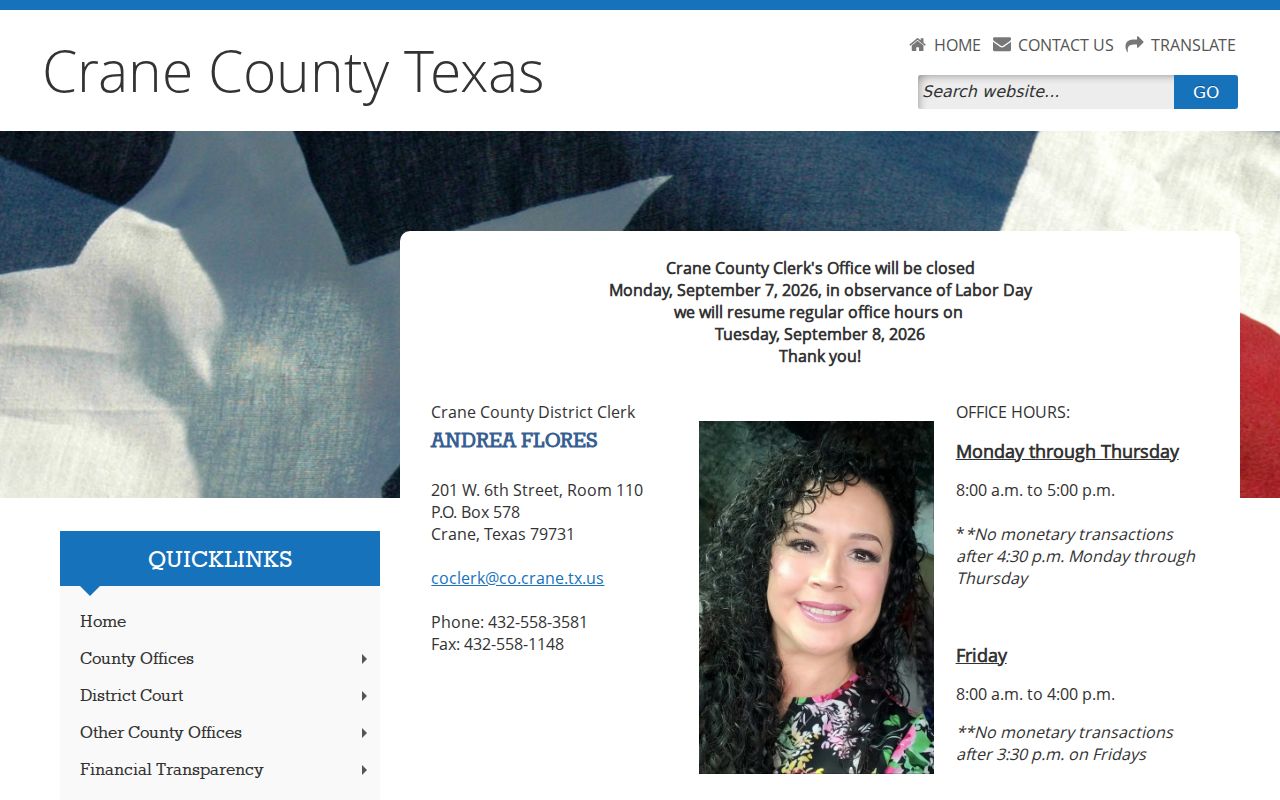
That office page ties the local custodian to the statewide case-search route. The clerk still backs you up when an image is unavailable, a certified copy is needed, or a case falls outside portal coverage.
Crane County District Clerk
201 W. 6th Street, Room 110
Crane, TX 79731
Mail: P.O. Box 578, Crane, TX 79731
432-558-3581
Fax: 432-558-1148
Email: coclerk@co.crane.tx.us
The current page lists Monday through Thursday, 8:00 a.m. to 5:00 p.m., and Friday, 8:00 a.m. to 4:00 p.m. Money transactions stop earlier: 4:30 p.m. Monday through Thursday and 3:30 p.m. Friday. Check the hours and payment cutoff before any deadline-sensitive visit.
Court Records: What They Contain
The statewide guide's representative case screen splits case metadata from parties, events, hearings, and documents. A Crane County result may not show every field or filing. Coverage turns on the court, the integration, the record date, your account rights, and access restrictions. An empty document cell can simply mean no public image is linked, not that nothing was filed.
| Location | The court and county attached to the case. |
|---|---|
| Case Category and Type | Broad and specific classifications such as civil, family, criminal, or probate. |
| Case Filed Date | The initiation date shown in the index. |
| Parties and Attorneys | Public names, roles, aliases, and counsel where available. |
| Events | Date, event, type, comments, linked documents, pages, price, and status in the representative guide. |
| Hearings | Published hearing type and date or time information. |
| Documents | Available, restricted, or separately purchasable filings. |
Court records can hold sensitive details. Crane's affidavit of indigence asks for identity, birth date, address, benefits, income, assets, expenses, and debts. It is a filing form, not a sample case. Never reproduce a completed private affidavit.
Crane County re:SearchTX Records
The official re:SearchTX guide covers case details, filings, hearings, alerts, folders, and a document cart. Seeing an event line as a public user is not the same as holding the document; you may still need to add it to a cart and check out. Document fees, the guide says, go to the court where the case resides. Portal access and clerk custody work together.
Pricing has shifted over time. Older materials put electronic pages at ten cents with a six-dollar document cap. A later FY2024 report listed ten cents per page with a one-dollar minimum per document. Those descriptions conflict. Check the price the cart shows before you buy, and don't assume either old rule is the live charge.
Portal failure: If re:SearchTX returns an access error, skip the portal and use the District Clerk or County Clerk by phone, at the counter, by mail, or by email instead.
A search result is not a certified copy. When you need certification, ask the clerk who holds the original file how to order one.
Copy Fees and Certification
Crane County's 2024 fee schedule sets $1 per copy page. Certified copies run $1 per page plus $5 certification per document. Authentication costs $10. The dated PDF still lists older clerk names, though current county pages name Andrea Flores, so confirm no newer schedule applies before you pay.
| Copy type | Published amount | Verification point |
|---|---|---|
| Plain copy | $1 per page | Confirm page count and delivery format |
| Certified copy | $1 per page plus $5 per document | Ask which document needs certification |
| Authenticated copy | $10 certification | Confirm all additional copy charges |
| Form search statement | $5 per search “to a certain extent” | Do not generalize this instrument-form language to every case request |
Don't read the schedule's civil and probate filing totals as copy prices. Those are filing charges. The same county form warns that credit-card payments add convenience fees. When you call, say whether your request involves a district case, a county case, a JP file, a municipal record, or a recorded instrument. Then ask for the current total.
Narrow a Crane County Record Request
The county form was built for land records. It asks for a recorded name, an instrument number, volume and page, and a document type. Those boxes suit official-record instruments, not court files. A Crane County case request needs different clues: the court, the cause number, party names or style, the case type, and the filing year or date range. Add the event or document name and say whether you want a plain copy or a certified one.
No cause number? Start with a focused Crane County docket search. Try name variants and the likely court. Send the clerk whichever case identifier matches best. The form itself warns that staff will not run complicated searches or give legal advice, so a tight request is the one most likely to reach the right item.
Mail goes to the clerk at P.O. Box 578, Crane, TX 79731. The current county page lists coclerk@co.crane.tx.us. The printed request form shows what looks like a “www.” prefix tacked onto that email, but trust the address on the current web page over that anomaly. The office also describes public viewing stations and record books anyone may use on site.
Note: Before relying on the county form's recorded-instrument fields or its search statement, ask whether it truly fits the court file you want.
Access Rules for Court Records
Access depends on the record's kind and status. A Texas Public Information Act request cannot replace the court's own case-record process. A public docket entry can exist while an exhibit, medical detail, child-protection report, or sealed filing stays closed.
Key Texas access rules:
Government Code §552.0035 directs judiciary access to Supreme Court rules and other applicable law.
Texas Rule of Judicial Administration 12 supplies the framework for covered judicial records outside ordinary case-file routes.
Texas Rule of Civil Procedure 76a provides a formal notice and hearing process for sealing court records.
Family Code §261.201 protects child-abuse and neglect investigation information subject to its terms.
Crane's 109th District Court DFPS standing order tightens the rules further. It covers DFPS court records. It allows access for DFPS, parties, attorneys, appointed representatives, and anyone with a court order. Not every family record is sealed. Ask the District Clerk which part of a specific file is public.
Restricted Crane County Case Records
Keep four search outcomes separate. A blank index is not a restricted result. A document that will not open is not a portal that fails to load. None of them tells you what happened in the case. A file may sit with another clerk. It might predate an integration, or be confidential by law. It could also hold a public event beside a sealed filing.
Statute, protective order, or court order can limit juvenile and some family information. Expunction and nondisclosure follow their own legal procedures, not ordinary copy requests. The County Clerk page links current material on those remedies. If you want a sealed item, ask about the court's access or unsealing procedure instead of filing repeated broad requests.
- Ask which clerk and court hold the case.
- Clarify whether the index entry, docket sheet, or actual filing is restricted.
- Request the rule, statute, or court order governing the response when appropriate.
- Use the court’s procedure for seeking access to a sealed item.
- Do not publish sensitive personal details from protected materials.
Certified status and public status are two different things. A page you can open on a portal is not automatically certified, and a certified copy can only include what the clerk may lawfully release.